
The Truck Wasn't Black (And There Were Three of Them)
It wasn’t black.
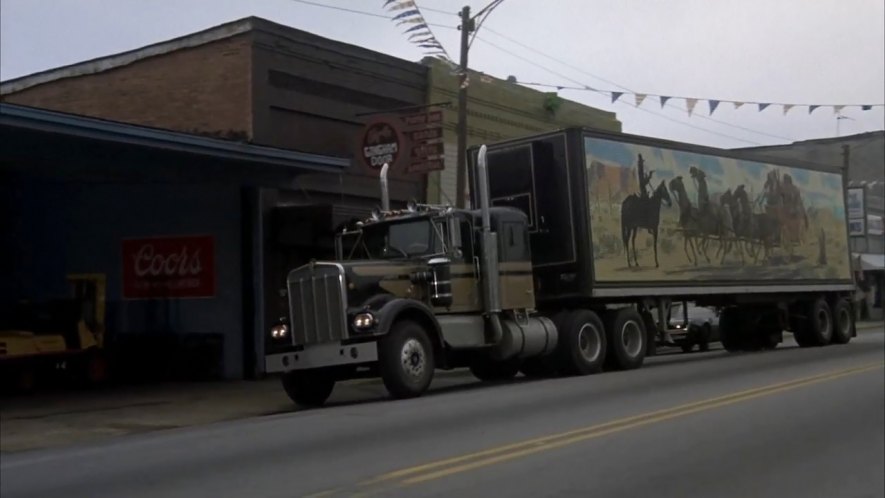
That’s the first thing people get wrong about Snowman’s rig in Smokey and the Bandit. The paint job everyone remembers — that deep, near-black finish rolling east through Georgia with 400 cases of Coors in the trailer — was actually a custom mix the production called Black Coffee. A true dark brown, rich enough to read as black under drive-in lighting in 1977, but brown all the same.
The paint everyone calls black was never black at all — it was a custom brown called Black Coffee, dark enough to fool a drive-in screen.
Here’s the second thing most people don’t know: there wasn’t one truck. There were three.
Three Kenworth W900As, built to look identical and rotated through production depending on what a given shot required, became one of the most recognizable rigs in American film history. Two were 1974 models. The third was a 1973 — a 50th-anniversary edition wearing a gold Kenworth emblem instead of the standard silver one. If you know to check the hood, you can tell which truck you’re watching in any given scene.
And nobody knows for certain where any of them ended up.
The Summer of 1977 Needed a Truck
The country was primed for this movie before it ever came out.
The national 55 mph speed limit had been law for four years. CB radios — already surging thanks to CW McCall’s Convoy two years earlier — were crackling across every interstate in America, and the format only accelerated once Smokey and the Bandit hit theaters. If you want to feel a piece of that era firsthand rather than just read about it, a CB radio setup is one of the more accessible ways in: check current listings here.
Smokey and the Bandit opened in New York in May 1977 to indifference, then caught fire once it hit Atlanta, Jacksonville, and Memphis. It grossed $126 million on a $4.3 million budget — second only to Star Wars that summer. Alfred Hitchcock, late in his life, reportedly named it one of his favorite films.
A corny highway comedy about smuggling beer outgrossed nearly everything else that summer — and Alfred Hitchcock loved it.
The premise: Bo “Bandit” Darville takes a bet — 400 cases of Coors, Texarkana to Atlanta, 28 hours. Coors was illegal east of the Mississippi at the time. The run needs a truck to carry the beer and a fast car to run interference. The Trans Am gets the poster. The Kenworth gets the job done.
That distinction matters more than it gets credit for. The Trans Am is theater. The W900A is the actual operation. Without Snowman and his rig, the Bandit is just a man in a black car driving fast with nowhere to go.
Choosing the Kenworth W900A
Three Trucks, One Look
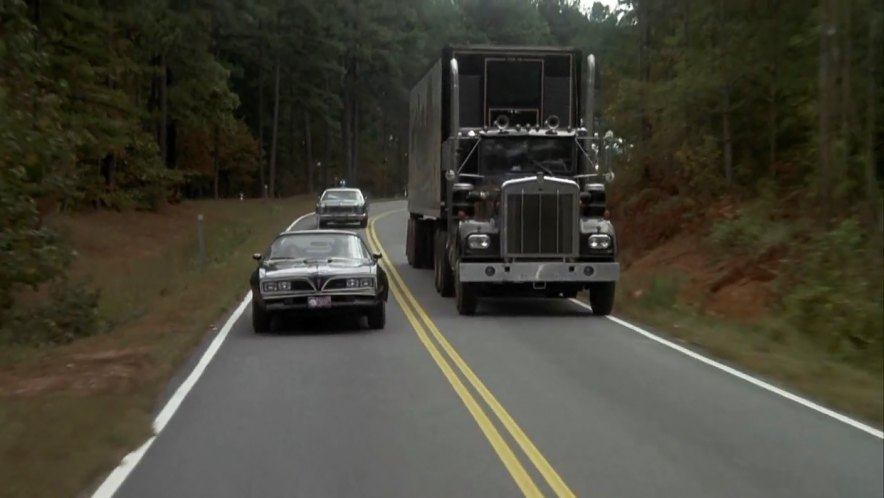
The W900A had been in production since 1965 — long hood, wide grille, chrome stacks rising above the cab. Truckers of the era called it the Cadillac of the highway, not as flattery but as a category unto itself. Director Hal Needham, a stuntman before he became a director, didn’t need a truck made to look powerful. He needed one that already was.
Three units went into the production. Two were 1974 models carrying the standard silver Kenworth emblem. The third, the 1973 unit, was a 50th-anniversary edition with a gold emblem in its place — the truck you’re watching whenever the hood catches the light just right.
Where those trucks were actually sourced is one of the article’s few genuinely unresolved points. One account places the sourcing with a Los Angeles-area Kenworth dealer with a track record of supplying Hollywood productions; another account instead points to a Georgia-based dealership. Neither claim carries strong primary documentation, and the two don’t agree — so this detail stays at a Reported tier rather than stated as settled fact.
Engine configurations varied across the three trucks as well. Reporting on the production consistently describes a mix of Cummins and, in at least one unit, a Caterpillar diesel — the exact engine-to-truck pairing (including a specific claim of a Detroit Diesel 8V71 in the primary unit) is less consistently corroborated across sources and is treated here as Reported rather than Confirmed. Whatever the precise pairing, the sound edit mixed audio from more than one engine depending on what a scene needed — the truck that sounds different from shot to shot isn’t a continuity error. It’s a different truck.
The Black Coffee Paint Job and the Mystery Muralist
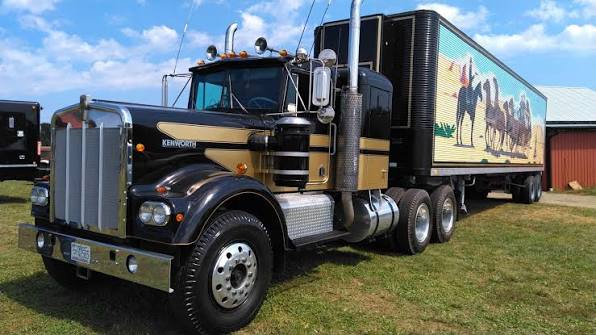
Cosmetic work on the trucks was otherwise straightforward: the Black Coffee paint, gold pinstriping on the front fenders, and Alcoa 10-hole polished aluminum wheels — a factory upgrade available on W900As of the era, and still recognized today as one of the more distinctive visual details of the build. A custom bullbar went on the stunt unit for the more aggressive driving sequences.
The trailer is its own story. A 1975 Hobbs refrigerated unit, hand-painted on both sides with an Old West stagecoach robbery scene — a mounted bandit, horses, a cactus, a jackrabbit parked off to the side like a punchline.
Who painted it is genuinely unresolved. One account credits a Texas artist; another names a different sign painter entirely. No primary documentation settles the question.
The mural exists on-screen in nearly every scene. The name of the person who painted it does not exist anywhere in the record.
That’s not a gap in this research — it’s a gap in the record itself, and it stays open rather than getting quietly resolved for the sake of a tidier paragraph.
Snowman, Jerry Reed, and "East Bound and Down"
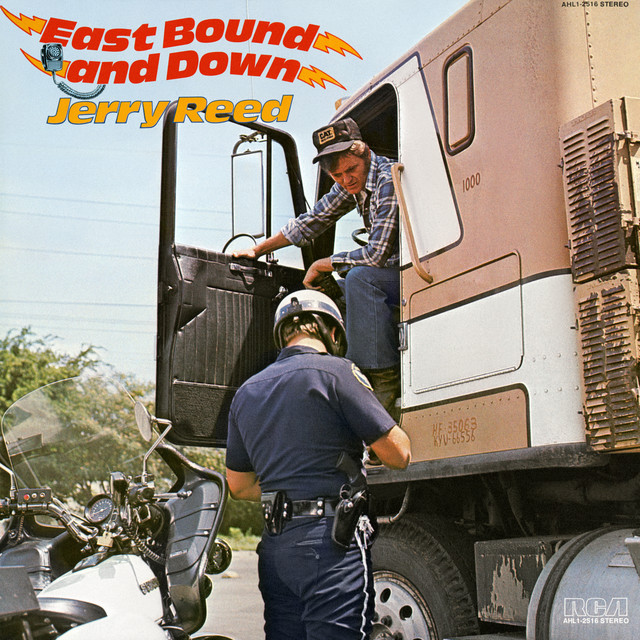
Jerry Reed played Cledus “Snowman” Snow. Reed was already a respected session guitarist and recording artist before the film, and he wrote and performed “East Bound and Down,” the theme that plays over the opening montage — it spent four months on the country chart and peaked at number two. The man driving the truck on screen also wrote the song playing while he drove it.
The actor behind the wheel wrote the song playing over his own driving montage.
The three trucks rotated through production depending on what each sequence demanded. The gold-emblem 1973 unit handled most interior shots, sometimes rigged with cameras and mounted on a lowbed. The two 1974s carried the highway work — and Needham, true to his stunt background, shot much of it on real roads at real speed. What the camera caught was largely what was actually happening.
Every scene involving the truck exists to answer one question: does the cargo make it? That’s not a subplot running alongside the Trans Am chase — it’s the spine the whole story is built on. Four hundred cases. Twenty-eight hours. One truck and the men who believed they could pull it off.
If you haven’t revisited the film itself recently — or want to see exactly how the truck reads on screen against everything documented here — the movie is worth the rewatch.
The Arkansas Lead: Decades of Looking
For years, a story circulated in the enthusiast community: one of the Kenworths — the last surviving truck from the production — was sitting in a field in northern Arkansas, covered in brush, supposedly visible on satellite imagery if you had the coordinates. People asked for those coordinates on forums for over a decade. Someone always claimed to have them. Nobody ever posted them.
Robb Mariani, who hosted the SPEED television series American Trucker, later retraced the film’s fictional 1,330-mile bootleg run — Atlanta to Texarkana and back — but did it in a replica of the truck, not the original. The Arkansas lead itself, as far as this research can confirm, was never run down on camera or resolved by that production.
A private collector reportedly went further still: hiring a private investigator, reaching people who’d actually worked on the production — set designers, transportation crew who were there. The trail went cold. This account comes from a single enthusiast-community source and hasn’t been independently verified, but its shape is consistent with everything else documented about these trucks: serious people looked seriously, and came back with nothing.
A collector hired a private investigator to find the trucks. The investigator came back with nothing.
The trucks have never surfaced. Not in a museum. Not in a private collection. Not in a cornfield in Arkansas.
What Happened to the Three Kenworths?
One account holds that after filming wrapped, the three Kenworths sat on a Santa Clarita-area studio lot used for storing production vehicles between films — the kind of yard where movie trucks and cars “rest” until called up for another job, a real and well-documented practice in the industry. Per that account, the trucks didn’t burn in a warehouse fire, despite a fire story that circulated for years. Instead, each was reportedly sold off in 1979.
It’s worth being direct about where this stands: most other sourcing on these trucks states flatly that their location and fate are currently unknown, with no mention of a 1979 sale anywhere in the wider record. The 1979 sale account isn’t corroborated by anything else this research turned up. It also isn’t contradicted by anything concrete — just by the much more common shrug of “nobody knows.” Readers should treat this section as a single account, not a settled record.
If the account holds, the gold-emblem 1973 unit was reportedly auctioned off the lot in 1980, went back to work hauling freight, changed hands again in the early 1990s, and was last tracked sometime around 1997 or 1998. Then nothing. Enthusiast accounts suggest it may have been converted to a daycab at some point — sleeper removed, the back of the cab closed up — which, if true, means the most visually distinctive part of Snowman’s truck was cut away by someone who may never have known what they had.
The two 1974 units disappeared more quietly under this same account. No auction record, no known subsequent owner. The trail simply ends in 1979.
The Hobbs trailer has a different thread. It reportedly turned up on the property of Riverwood Studios in Senoia, Georgia — where The Walking Dead filmed for years — and a trailer matching its description appeared as a background prop in Season 7. Whether that’s the actual screen-used trailer or a replica built to resemble it is disputed; one credible source points to anachronistic side skirts, a detail not common on trailers from the original production era, suggesting the Senoia trailer may not be what it looks like. This remains unresolved.
Three trucks carried a film that grossed more than thirty times its budget and made the W900A one of the most recognizable semis in American popular culture. By whichever account you credit, they went back into ordinary commerce for whatever a used Kenworth was worth at the time.
They carried a legend for one summer, then went back to being trucks. Nobody was required to save them. Nobody did.
Building a Tribute: What It Takes to Recreate Snowman's Truck
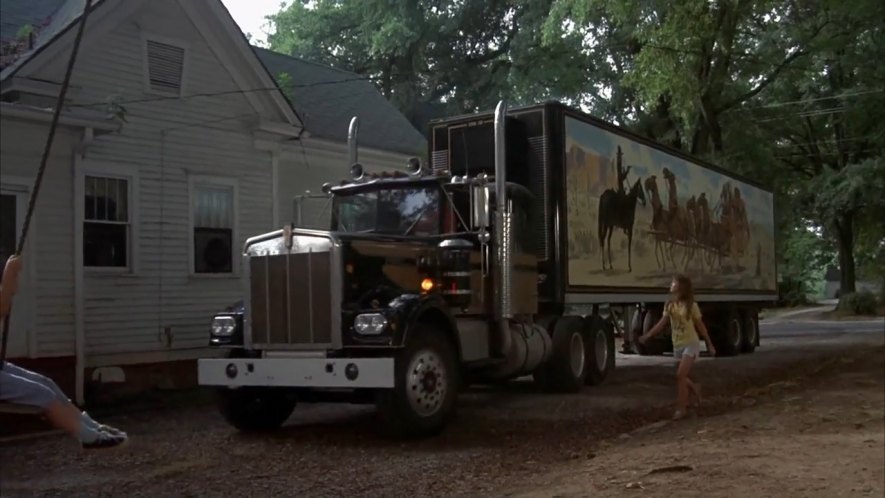
The W900A ran in production from 1965 to 1982. For an accuracy-minded tribute build, the target window is 1973 or 1974 — the actual model years of the screen trucks. Any wide-hood A-model gets you into the right visual territory, but an early-to-mid-seventies example carries the correct grille, emblem, and proportions.
These trucks do surface. Running, presentable examples have sold in the fifteen-to-forty-thousand-dollar range, with show-quality restorations running considerably higher. The market is thinner than the classic-car market, but it exists.
The visual package itself is achievable. The Black Coffee paint is a custom mix, but any competent body shop can match it from reference photos. The gold pinstriping is straightforward. The Alcoa 10-hole wheels are still in production through commercial truck suppliers. The bullbar is fabrication work, but nothing beyond a decent chassis shop’s capabilities.
The trailer mural is the hardest piece to reproduce — the original was hand-painted by an artist whose identity remains genuinely unresolved. A skilled sign painter can work from film stills, or a high-quality vinyl wrap offers a modern alternative that sidesteps the sourcing problem entirely while still holding up at truck shows.
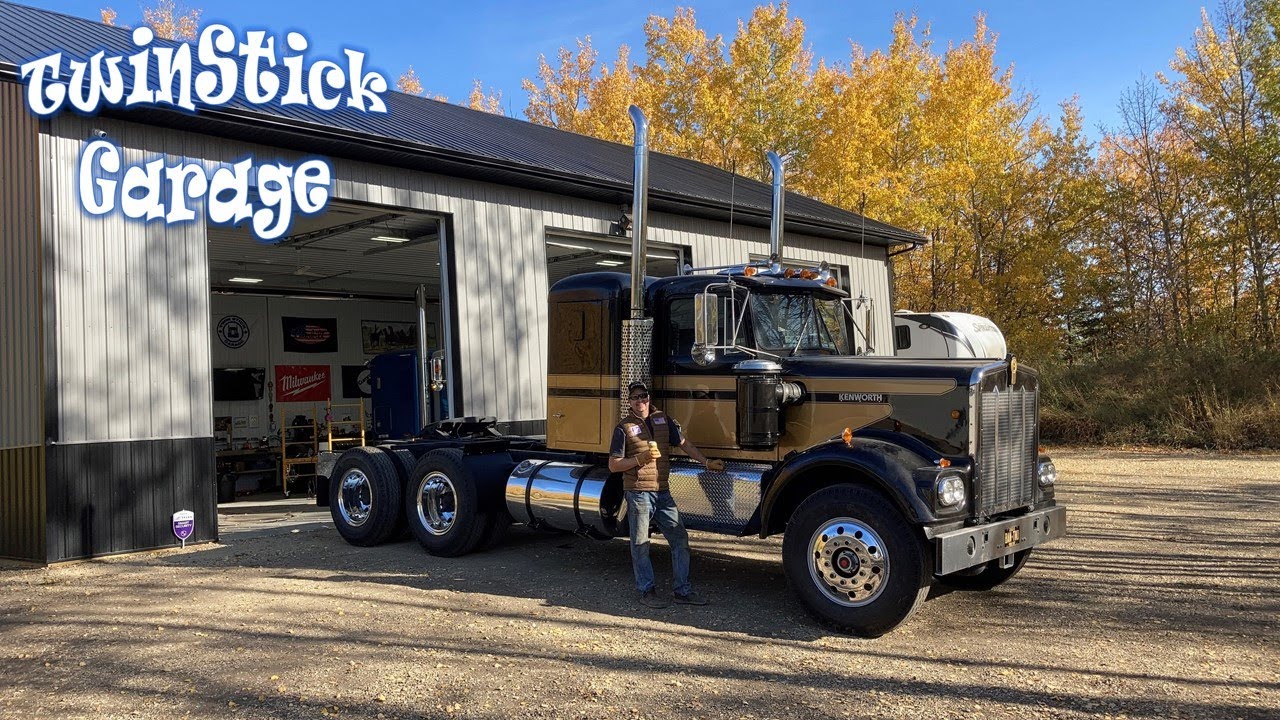
At least one documented tribute build demonstrates the full package is achievable at a high level — a build worth studying before sourcing parts, though it’s worth noting the donor truck in that specific build is a later model year than the screen-accurate 1973/1974 window. Brad Wike and Twin Stick garage both have tributes. Twin Stick garage has an entire series on YouTube for you to follow along.
The Trucks Nobody Required Anyone to Save
Here’s what the ledger did with them.
By most accounts, three trucks built a myth and then simply vanished back into ordinary commerce — used equipment, depreciated, sold or scrapped without much ceremony. One may have hauled freight for twenty years before someone removed the sleeper and nobody wrote down where it went afterward. The other two left with people who needed working rigs, not relics. That’s not a tragedy with a villain. It’s just how most things go.
What the ledger didn’t account for is the people who kept looking anyway. The forums that have been running this argument since the mid-2000s. The collector who hired an investigator. The television host who retraced the route in a replica because the real thing couldn’t be found. None of them were required to care. The trucks were used equipment sold at fair market value. By any practical measure, the story was finished.
Except it wasn’t. It never quite is, with things that meant something to people.
Somewhere — or in pieces, or in nowhere at all — there are three Kenworth W900As, or what’s left of them, that spent one summer in 1977 carrying a legend east on a deadline. After that, they went back to being trucks. The country that loved them stopped watching. Just not everyone did.
Nobody required them to keep looking either.