
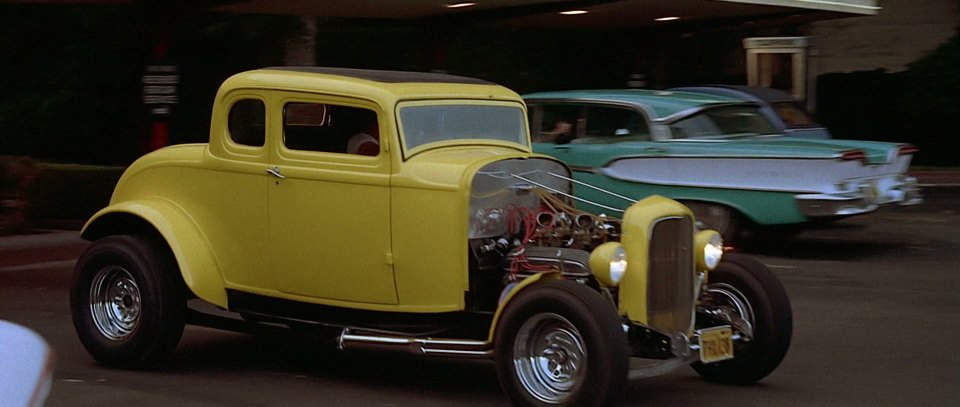
A yellow deuce coupe sat behind a soundstage for over a decade. Nobody moved it. Nobody claimed it. It just sat there, because the film it starred in had already made its money, and the car was never anything more than a prop line item to the people who owned it.
That’s the part nobody tells you about movie cars. The camera doesn’t care what happens after it stops rolling. Once a production wraps, these vehicles get sold off, scrapped, forgotten, or simply left somewhere until somebody needs the space. What follows are nine hot rods that were built by hand, filmed, discarded, and then, against every likelihood, kept alive. Some were rescued from real decay. Others were saved by a single owner who never let go in the first place. Every one of them still exists today. None of them survived because a studio thought they mattered.
This article contains affiliate links. If you purchase through one, Retro Reel Rides may earn a commission at no extra cost to you.
The car cost thirteen hundred dollars off a used lot in California. That’s it. That’s what it takes to buy the single most recognized hot rod in American film history, if you’re buying it before anyone knows what it’s going to become.
George Lucas wanted a down-and-dirty street racer for his film about one long night of cruising in 1962 Modesto. The production stripped the fenders off, chopped the grille, dropped in a 327 with six carburetors, and painted the whole thing a yellow so bright it reads as a character in its own right. On screen, it’s “the fastest thing in the valley.” Off screen, it was a rag — Lucas’s own word for it.
When filming wrapped, the coupe went back to Universal, where transportation manager Henry Travers sold it off cheap, along with the black ’55 Chevy used in the same film. Both cars went to Steve Fitch, a Kansas City collector, around 1981. Fitch stripped the coupe down, cleaned it thoroughly, and had a custom “MILNERS” plate made for it. Rick Figari, a San Francisco firefighter, bought it from Fitch in 1985 and still owns it today, touring it to hot rod shows four decades later.
Here's where the story gets complicated in the best way
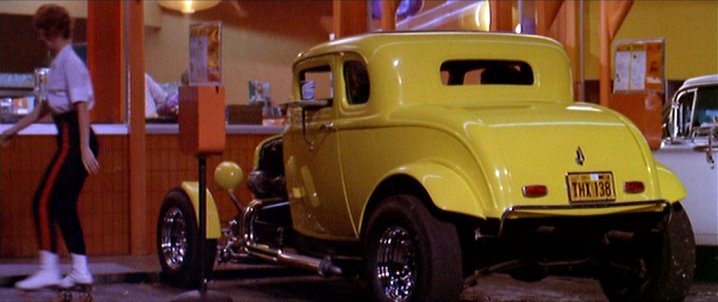
The widely repeated version says Figari popped the trunk and found the original piston-shaped gearshift knob and a THX 138 license plate — an easter egg nodding to Lucas’s first film — sitting untouched since 1973. It’s a good story. It’s also disputed by the two men closest to it: Fitch, who says he cleared the car out completely before selling it, calls the trunk-discovery version folklore. Figari himself, in an earlier interview, said the opposite — that he was disappointed to find the plate and shifter missing when he took ownership, and that he acquired the actual THX 138 plates later, separately, from Travers’s widow.
If you’ve ever wondered why the plate reads “THX 138” instead of the full “THX 1138,” that part isn’t in dispute — it’s a direct reference to Lucas’s 1971 debut film, planted as a running joke the crew carried from one production to the next.
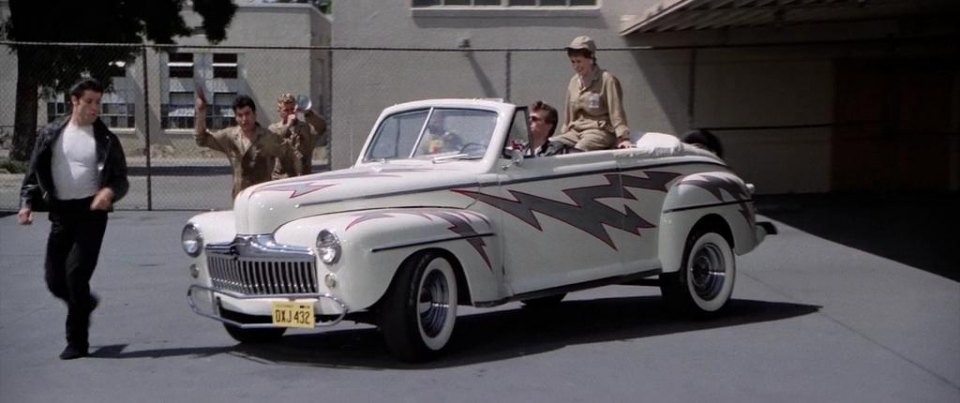
Kenickie’s convertible starts the film as junk — cracked windshield, missing parts, the kind of car a shop teacher makes fun of in front of the whole class. Then the T-Birds sing about what it could become, and for three minutes it is.
Movie car builder Eddie Paul built dozens of vehicles for the production. The 1948 Ford Super De Luxe carrying the “Greased Lightning” identity — cataloged as build 89A-76B — was the primary hero car, used extensively through the film. A second, separately cataloged 1946 Ford Super De Luxe (69A-76), also built by Paul, appears only in a minor capacity. That’s the real source of decades of fan confusion: two different Fords, both built by the same shop, both associated with the name, in very different roles.
What’s better documented is the film’s other custom build: “Hell’s Chariot,” the black flamed 1949 Mercury driven by rival Craterface. That car has a clean, well-papered chain of custody — rediscovered as a shell at a Huntington Beach shop, authenticated by Paul himself, restored, sold at Julien’s Hollywood Auction in 2015 for $478,000, resold at Julien’s again in 2018 for $600,000, and consigned to Mecum in 2022 with an estimate of $600,000–$750,000.
The two cars' fates have been quietly swapped in fan retellings for years.
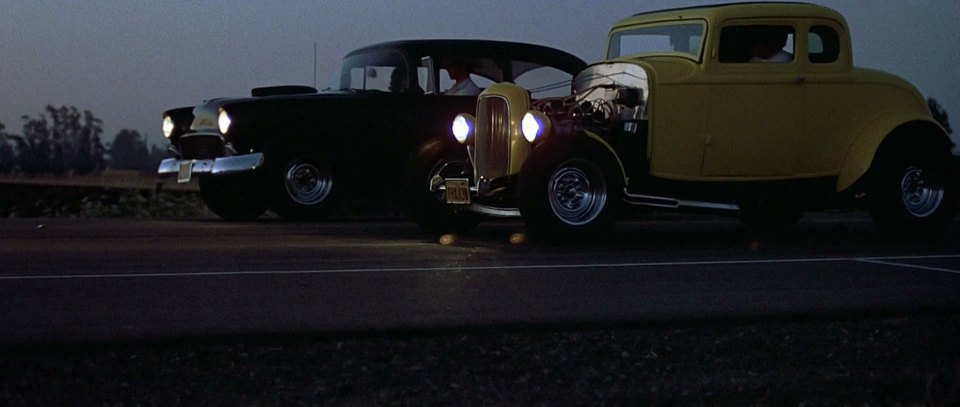
This car wasn’t built for American Graffiti at all.
Two years earlier, builder Richard Ruth constructed three matching 1955 Chevrolet 150s for a different film — the stripped-down road movie Two-Lane Blacktop. Powder blue underneath, gray primer on top, tunnel-ram 454s under the hood. When producer Gary Kurtz moved on to work with George Lucas on Graffiti, he remembered those Chevys and knew exactly which car Harrison Ford’s character needed to drive.
Two of the three cars were repainted black and brought back for Graffiti. One was destroyed during the film’s climactic rollover — a real car, sacrificed for a few seconds of footage. The other survived, was restored to its Graffiti appearance, and ended up in Rick Figari’s collection alongside the yellow coupe. Ruth reportedly built Figari an additional matching car later, finished to Harrison Ford’s exact spec, as a personal favor.
If you’ve ever wondered why Falfa never pops his hood in the movie, it’s because there was a monster big-block sitting under there that had no business existing on the streets of 1962 Modesto. The production knew it. They just never let the camera find out.
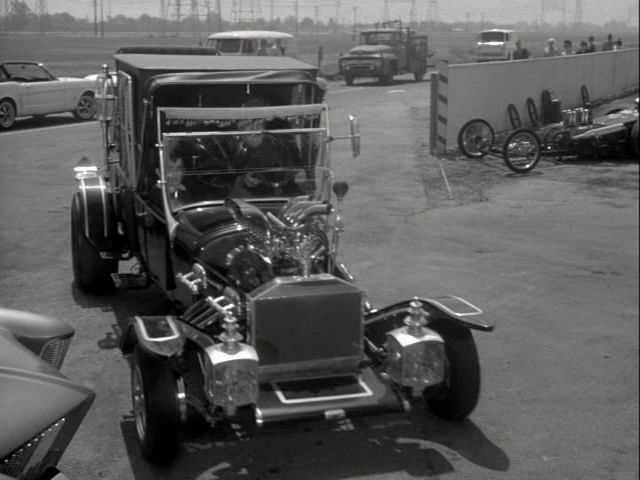
George Barris built the Koach from three 1927 Model T bodies stretched over a custom chassis, with a supercharged 289 under a coffin-shaped hood. It took roughly 500 hours of hand-formed scrollwork alone and cost about $18,000 to build in 1964 — north of $180,000 today.
Here’s the correction worth making plainly: this car’s ownership trail is not the clean, unbroken story it’s often told as. Barris auctioned the original Koach himself in the early 1980s, already modified from its screen spec — different headlights, different tires. A second, “authorized” Koach was built in 1984 by Dick Dean for a Hollywood Christmas Parade appearance, restored again in 2011. Current sourcing splits on where the “original” actually lives — some accounts place it at the Volo Auto Museum in Illinois; others describe an exhibition Koach still held in the Barris family’s own inventory, wheeled out for shows by George Barris’s daughter, Joji Barris-Paster. Multiple licensed re-creations, built to museum quality, have also crossed the block at Barrett-Jackson in recent years, muddying things further for anyone trying to track “the” car.
There may not be a single answer to where the Munster Koach is — there may be two survivors with a legitimate claim
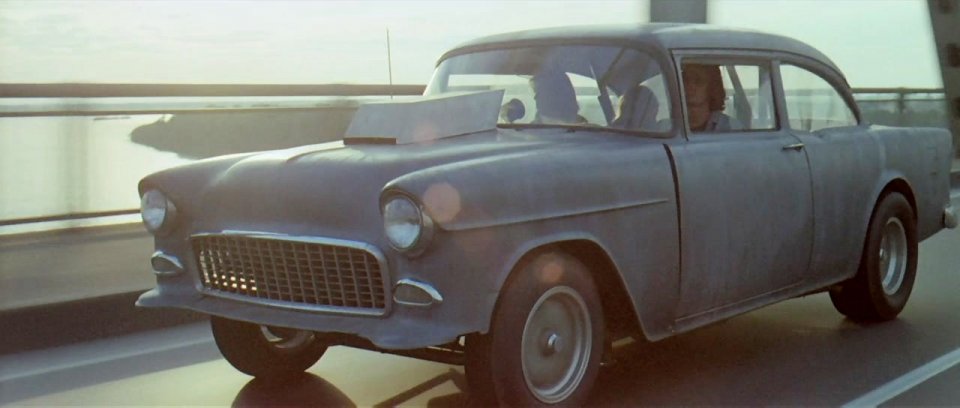
This is the third of Richard Ruth’s three matching ’55 Chevys — the one used for interior shots, the one with camera mounting brackets bolted into the dash.
After filming, it went back to Universal’s lot along with the other two. A studio mechanic bought it, pulled the big-block for use in a boat, and rebuilt what was left as a daily driver. From there it drifted through a string of owners until Two-Lane Blacktop historian Walt Bailey located it in Canada around 2000. Ruth himself authenticated it — the fiberglass doors had been swapped for steel, the front end replaced with a Camaro clip, but the original chassis and camera mounts he’d installed in 1970 were still there underneath.
Bailey spent roughly five years restoring it to its on-screen appearance, replacing sheet metal sourced through a local Chevrolet dealership and hunting down parts like the original fiberglass doors, which had ended up on a different car entirely.
This is the only Two-Lane Blacktop picture car that survives looking the way it did on screen
It sold at Barrett-Jackson’s Scottsdale auction on January 17, 2015, for $159,500.
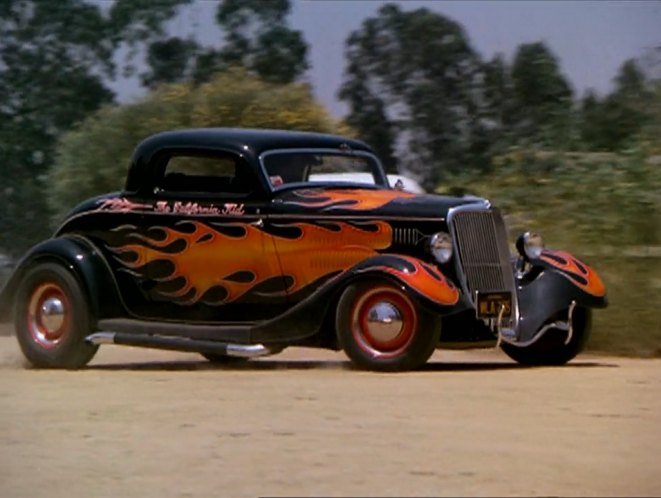
Pete Chapouris built this 1934 Ford three-window coupe the traditional way, at a moment when traditional wasn’t fashionable. Chopped top, full black paint, hand-laid flames by Manuel Reyes. Then a television producer saw the coupe on a magazine cover and cast it in a TV movie alongside a young Martin Sheen. The production had no stunt budget, so Chapouris’s coupe did all of it — every chase, every high-speed pass, filmed for real.
There’s no lost chapter here. Jerry Slover bought the car along with Chapouris’s business in 1986 and has owned it ever since, driving it through nearly a hundred thousand miles across four decades. It sits today in Peculiar, Missouri, largely unchanged, still carrying its original 340-horsepower engine.
Not every survival story needs a rescue. Sometimes the whole point is that nobody ever had a reason to let go.
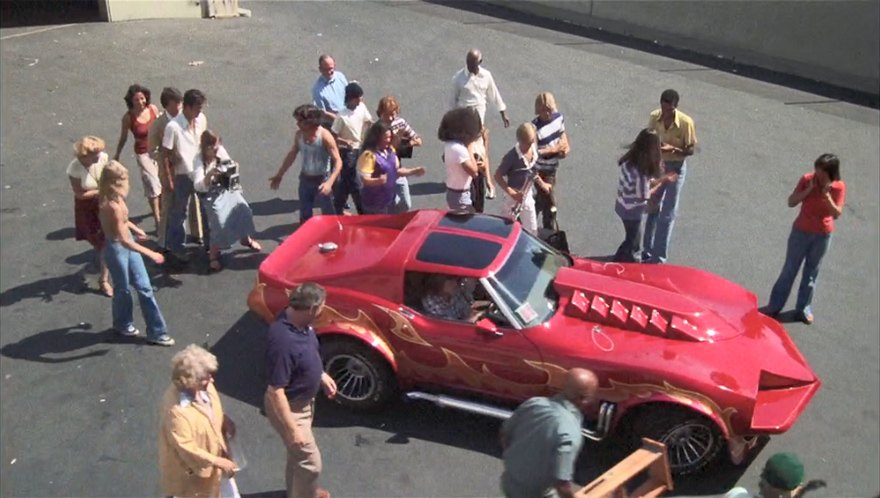
The plot of this film is about a stolen custom car. The real history of the car itself is well documented.
Built by Dick Korkes of Korky’s Kustom Studios for MGM, two 1973 Chevrolet Corvette Stingrays were made — a main car and a backup — reworked with flared fenders, a shark-nose front end, and right-hand drive. [HIGHLIGHT: One purity note worth flagging: a seller’s listing years later claimed the car was a 1977 model. It wasn’t — both were 1973s, and the mismatch is a good reminder to verify a seller’s story against the paper trail, not the other way around]. The main car went to an Australian collector and was altered well past recognition. The backup stayed in the US with Mike Yager of Mid America Motorworks, on display in Effingham, Illinois, until he sold it to a private collector in late 2009 — it remains in the US today. A mold of the film car’s body, once part of the Corvette Americana Hall of Fame, is now in the National Corvette Museum’s collection.
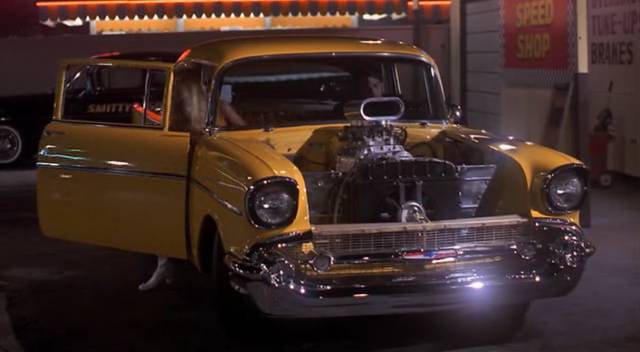
Before this yellow ’57 Chevy ever appeared on screen, it had already lived an entire life. Popular Hot Rodding magazine bought it in 1965 for two hundred and fifty dollars and turned it into a running project — a car readers wrote in about, argued over, and watched evolve issue after issue for years before Hollywood ever got involved.
By 1980, when it appeared as Tony Danza’s ride in The Hollywood Knights, Project X was already fifteen years into a life that had nothing to do with movies. The transmission actually broke during filming — that’s real smoke rolling over the car in the race scene, not an effect.
What makes this one different from everything else on this list is that it was never rescued, because it was never abandoned. The magazine kept modifying it for sixty years straight — inline-six, small-block, big-block, fuel injection, superchargers, even a widely mocked 2021 detour into a 340-horsepower electric drivetrain that got reversed after heavy reader backlash. Its current build runs a 632-cubic-inch big-block making 1,004 horsepower.
Sixty years in, and Project X still isn't finished. That was never the point
Before he was known for anything else, Tommy Ivo was a young actor obsessed with a hot rod he’d seen at a burger stand in Burbank — a T-bucket built by fellow actor Norm Grabowski, whose own car later became known as the “Kookie Kar” from 77 Sunset Strip. Ivo asked to measure it. Grabowski said no. So Ivo snuck into Grabowski’s garage while he was out and took the measurements himself.
He built his own version with help from engine man Max Balchowsky, running a Buick nailhead. The car appeared in The Choppers and ran genuinely fast — consistent eleven-second quarter miles, a show-car body doing real work at the strip.
Then it disappeared into someone else’s vision entirely. Ivo sold it to Bill Roland, who made changes before selling it again to Hy Rosen in 1962. Rosen took it to George Barris, who reworked it into a glitzy show piece — more chrome, a different color, an interior built for spectators rather than drivers.
Decades later, Hy’s son Jack Rosen decided the car deserved to go back. Builder Ron Jones, working from an old Hot Rod magazine feature as a guide, stripped away the Barris-era additions and reconstructed the original specification piece by piece. For the final pinstriping, Von Dutch — the man who’d striped the car for Ivo back in 1955 — laid the lines down himself. It was one of the last jobs he did before he died.
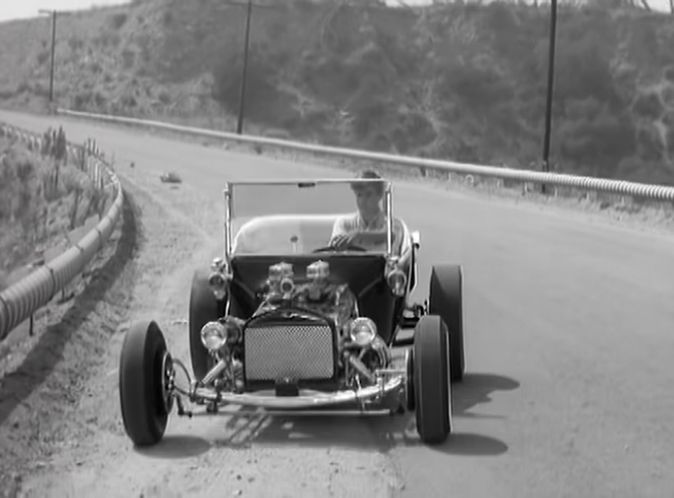
The car spent years afterward on loan to the NHRA Motorsports Museum in Pomona. Today it sits in Jack Rosen’s garage — restored not to what someone else made it, but back to what it originally was.
None of these nine cars survived because anyone was required to save them. No studio archived them. No law protected them. A firefighter bought a coupe because he liked the way it looked. A magazine just never stopped tinkering with a car it bought for two hundred and fifty dollars in 1965. A son spent years undoing what a show-car makeover had done to his father’s purchase, just to get back to the original.
That’s really the throughline here. Hollywood built these cars to serve a few weeks of filming and then walked away without a second thought. What happened after that had nothing to do with the industry that made them famous. It came down to individual people — mechanics, collectors, sons finishing what their fathers started — who looked at a piece of forgotten metal and decided, on their own, that it was worth the trouble.
Watch the full video breakdown of these nine cars on the Retro Reel Rides YouTube channel.